
The weak spots in a house are the places where two materials meet. If you are planning a custom home, this post explains how we seal ZIP System sheathing, the foundation joint, and every line that passes through the wall before the siding goes on.
None of this work shows once the house is finished. That is why it matters.
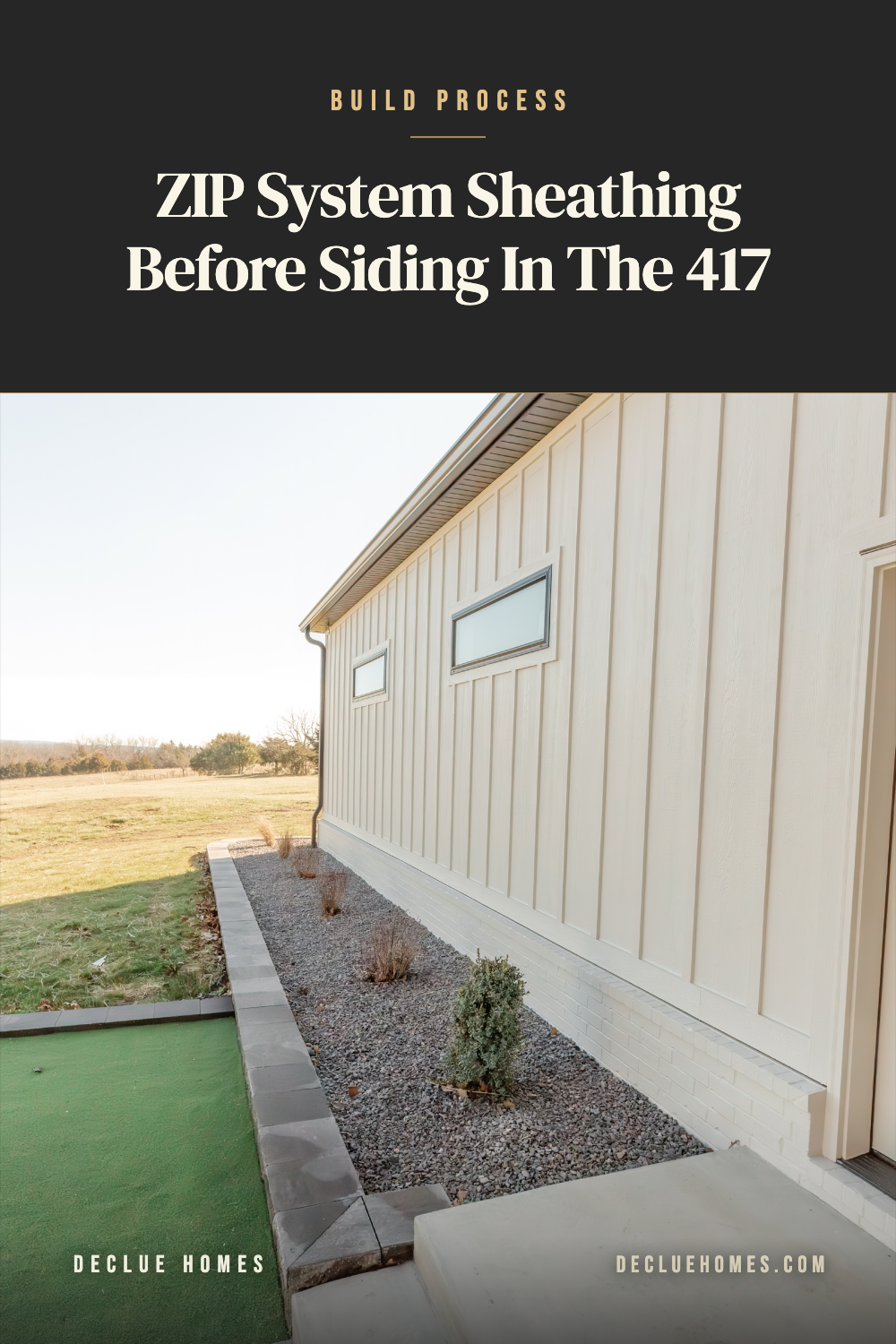
What ZIP System sheathing does for the building envelope
The building envelope is everything that separates the inside of a house from the outside: the foundation, walls, roof, windows, and doors. Its job is to keep out air, water, and bugs so the inside stays comfortable and dry.
On our builds, the walls are covered in ZIP System sheathing. These are structural oriented strand board (OSB) panels with a weather resistive barrier built into the face, so the wall does not need a separate layer of house wrap. Huber, the maker of ZIP System wall sheathing, pairs the panels with ZIP System tape over the seams. Together, the panels and tape form a continuous air barrier.
Continuous is the important word. Building Science Corporation's guide to air barriers explains that an air barrier has to run unbroken over the whole enclosure to work. Air that slips through a gap carries moisture with it, and moisture is hard on a wall over time.
The sheathing gives us a strong start. Our job is to close the gaps the sheathing cannot close by itself.
Sealing the joint where the foundation meets the wall
The first gap sits at the bottom of every wall. Our framing rests on top of the concrete foundation, so a joint runs between the concrete and the sheathing around the entire house. Left open, that joint is a path for air, water, and insects.
We cover that joint with a tape made to connect concrete to sheathing. On this build, we used SIGA Fentrim 430, an exterior tape that bonds to concrete and masonry without a primer. It seals the full perimeter of the house.
The payoff is a tighter house. Less air leaks in and out, less moisture reaches the framing, and the home runs more efficiently.
It is a low-effort step with a large return.
Why the flashing tape sets the siding schedule
This tape is not made to sit in the sun for long. The manufacturer rates it for up to four months of UV exposure in our climate. Past that window, the tape's warranty no longer applies, and it may not perform the way it was designed to.
That rating ties two parts of the build together. Once the tape goes on, the siding has to cover it within four months. Weather can shift a schedule in southwest Missouri, which is one reason we plan the build around the seasons. The four-month window is one more date we track.
The siding also has to cover the tape completely. On this build, the exterior is LP SmartSide lap siding, a painted horizontal lap product on an OSB substrate. Before the tape went on, we walked through the layout with our siding installers.
We pop a chalk line two inches below the joint where the framing meets the foundation, and the tape runs down to that line. The first lap board starts two and a half inches below the same joint. That leaves half an inch of siding lapped past the bottom edge of the tape.
No tape is left in the sun, and the seal stays protected behind the siding.
Sealing every penetration from the outside in
The foundation joint is the longest gap, but it is not the only one. Every line that comes into the house passes through the wall: hose bibs, electrical service, gas and water lines, and internet cable.
We seal each of those openings with a liquid flashing product rated for exterior and interior use. The line still comes in. The air, water, and bugs stay out.
This work happens between framing and siding, one of the stages of a custom build that most homeowners never see up close. Once the siding goes up, it stays covered for the life of the house.
That is the reason to do it right. A house built to last depends on the hidden work as much as the details that make a home feel finished.
Every place two materials meet gets sealed, long before the siding goes on.
